
Cardiovascular disease is the single largest cause of medical disqualification for U.S. pilots. The good news: the FAA has spent the past decade building progressively more nuanced pathways for pilots with coronary artery disease (CAD), and the coronary artery calcium (CAC) score is now squarely embedded in those pathways. The 2026 FAA Guide for Aviation Medical Examiners (pages 480-481) explicitly references CAC scoring in the cardiovascular workup, and it has become one of the most powerful tools an AME can use to either keep a pilot in the cockpit or catch silent disease early.
This article walks through what a CAC score is, the score ranges and what they mean, exactly how the FAA treats your score during the medical certification process, and the practical pitfalls pilots run into when they get a CAC scan without first talking to their AME.
What Is a Coronary Artery Calcium (CAC) Score?
A CAC score — also called an Agatston score, after Dr. Arthur Agatston who developed it in 1990 — is a number derived from a low-dose, non-contrast CT scan of the heart. The scanner measures the volume and density of calcified plaque in the coronary arteries. Calcium in those arteries is a direct, anatomic marker of atherosclerosis — the underlying disease process that causes heart attacks.
The test takes about ten minutes, requires no IV contrast, no exercise, and no fasting. Radiation exposure is roughly equivalent to a mammogram (~1 mSv). Most cash-pay scans run between $75 and $250 in the U.S.
The output is a single integer. Higher is worse. The standard interpretation ranges, used by both the American College of Cardiology and the FAA's consulting cardiologists, are:
- 0 — no detectable calcified plaque. Very low 10-year risk of a cardiac event (typically <1%). The "warranty period" for a zero score is roughly five years.
- 1 - 99 — mild plaque burden. Low to mild risk. Often seen in middle-aged pilots with otherwise normal lipid panels.
- 100 - 399 — moderate plaque burden. Significant CAD is present, even if the pilot is asymptomatic. Annual cardiac event risk rises into the 1-2% range.
- 400+ — extensive plaque burden. Equivalent risk to a patient with known CAD. The FAA almost always wants additional functional testing (stress test, stress echo, or cardiac CTA) before issuing.
- 1,000+ — severe burden. Workup is essentially identical to a known-CAD pilot.
Why Pilots Care: The Two-Edged Sword
CAC scoring is genuinely useful for pilots — and genuinely dangerous if you order it without thinking through the FAA implications first. There are really two scenarios that play out in our clinic:
Scenario 1: The Reassuring Zero
A 52-year-old airline pilot with mildly elevated LDL gets a CAC scan as part of a wellness physical. The score comes back zero. He brings the report to his AME at the next exam. The AME notes the result, the pilot is issued in the room, and the pilot now has objective evidence of low cardiovascular risk that protects him for years to come. This is the win case.
Scenario 2: The Surprise Positive
A 47-year-old corporate pilot, marathon runner, no symptoms, gets a CAC scan because his father had a heart attack at 55. Score comes back at 320. He is now legally required to report this on his next MedXPress application (Item 18 — "do you have any other medical condition not previously listed"), and the FAA is going to want a full cardiovascular workup before they issue. He is potentially looking at a 60-90 day deferral, a stress echo, possibly a cardiac CTA, and likely a Special Issuance Authorization with annual recertification requirements. This is the pilot who wishes he had called his AME first.
Bottom line: Once a CAC score exists in your medical record, you must report it. The FAA is not negotiating on this. Have a conversation with your AME before scheduling the scan so you understand the certification consequences of every possible result.
What the FAA AME Guide Says (2026 Edition, Pages 480-481)
The current AME Guide explicitly references coronary artery calcium scoring within the Cardiovascular Disease Evaluation Specifications. The Guide treats CAC scoring as one of several acceptable risk-stratification tools that the FAA's cardiology consultants will consider when evaluating an asymptomatic pilot for Special Issuance.
The most useful piece of guidance on page 481 is the disposition table reproduced below. It shows exactly how the FAA expects an AME to act on any given CAC or CCTA result — "Issue" in the room, defer for a Special Issuance (RS*), or send the pilot for a cardiac cath or CCTA with CT-FFR.
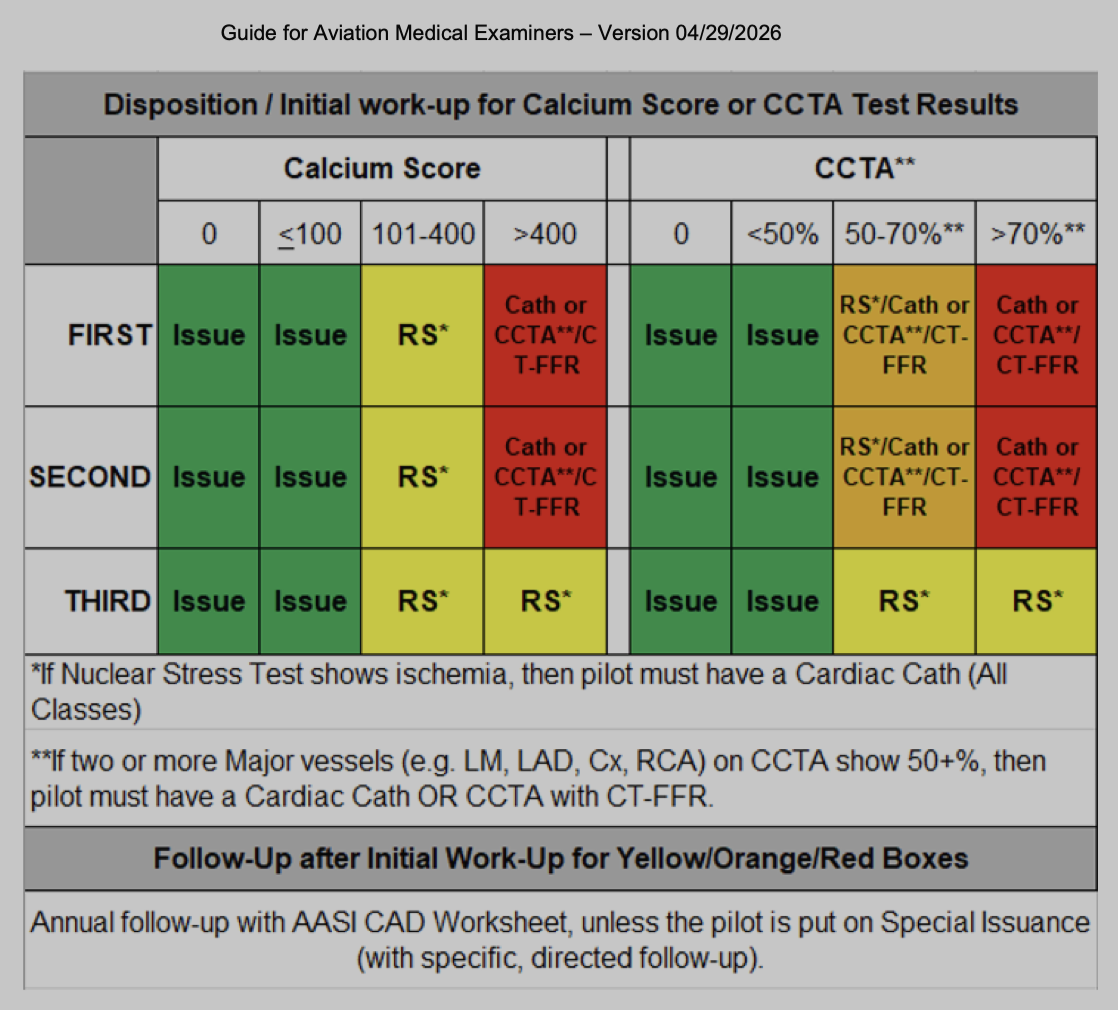
A few things worth noticing about this table:
- The first two exams are the strictest. A first-time CAC of 101-400 means a deferral and Special Issuance workup (RS*); a score >400 means the pilot must go straight to a cardiac cath or CCTA with CT-FFR. The third exam relaxes slightly — once you have a track record, scores in the 101-400 and >400 ranges can be handled with the Special Issuance pathway rather than another cath.
- CCTA tells a more nuanced story than calcium alone. Stenosis under 50% is "Issue," 50-70% on the first two exams triggers cath or CCTA/CT-FFR, and >70% always triggers cath (unless you are on your third exam, in which case RS* is acceptable).
- The asterisks matter. Per the table footnotes: if a nuclear stress test shows ischemia, the pilot must have a cardiac cath (all classes). And if two or more major vessels (LM, LAD, Cx, RCA) on CCTA show ≥50% stenosis, the pilot must have a cardiac cath or CCTA with CT-FFR.
- Follow-up is annual. The bottom of the table is explicit: yellow / orange / red boxes get annual follow-up with the AASI CAD Worksheet, unless the pilot is placed on Special Issuance with a specific directed follow-up schedule.
Additional practical points from the Guide:
- A CAC score is not, by itself, disqualifying. The FAA disqualifies based on confirmed coronary artery disease (per 14 CFR 67.113, 67.213, and 67.313), not based on calcium alone.
- Any CAC score >0 establishes that atherosclerosis is present, which the FAA considers diagnostic of asymptomatic coronary artery disease for certification purposes.
- Pilots with a CAC score >100 will typically be asked for additional functional testing — most commonly a maximal exercise stress test or stress echocardiogram — before initial Special Issuance.
- Once Special Issuance is granted for asymptomatic CAD, the standard recertification interval is annual, with periodic functional testing per the issuance letter.
- A CAC score of zero on a properly performed study can be used as evidence to simplify the cardiovascular evaluation in pilots being worked up for other reasons (e.g., chest pain that turned out to be non-cardiac).
What Happens at Your AME Exam After a CAC Scan
Walk through the realistic process so there are no surprises:
- You report the test on MedXPress. Item 18 captures any new medical event or test since your last exam. Attach a PDF of the CAC report if you can — your AME will need it.
- Your AME reviews the score. If the score is 0, most AMEs will document the result, note the absence of CAD, and issue in-room (assuming everything else is normal).
- Scores 1-99 are usually issued without deferral, though the AME will document the finding and may recommend lifestyle / lipid optimization.
- Scores 100-399 almost always require additional testing before issuance. Expect your AME to defer to the FAA, who will request the full cardiology workup. Plan for 60-120 days.
- Scores 400+ trigger the full asymptomatic CAD workup: maximal exercise stress test, stress echo or stress nuclear, lipid panel, and a cardiology consultation. Special Issuance is the typical outcome — but the path is well established.
Reporting: Don't Try to Hide It
This is the section every AME wishes pilots read twice. You must report any CAC score you have ever received on your MedXPress application. The FAA has access to a remarkable amount of health-record data, and falsification of a medical application is a federal offense (18 U.S.C. § 1001) that carries criminal penalties and permanent loss of certification.
If you got a CAC scan five years ago and have never reported it because no one asked, the cleanest move is to bring the report to your AME at your next exam, disclose it, and let the system work as designed. The pathway to Special Issuance for asymptomatic CAD is well-trodden. The pathway back from a falsification finding is not.
Should You Get a CAC Scan? Talk to Your AME First.
For pilots with a strong family history of premature CAD, multiple risk factors (hypertension, dyslipidemia, diabetes, tobacco use), or new symptoms, a CAC scan is a powerful diagnostic tool. For pilots with no risk factors, no family history, and a clean lipid panel, ordering a CAC scan as a "just in case" wellness test is a higher-stakes decision than most pilots realize.
At Go Flight Medicine we do not discourage pilots from getting CAC scans — early detection of CAD genuinely saves lives. But we strongly encourage a 15-minute conversation with your AME first to walk through:
- What your pre-test probability of disease actually is
- What you will do with each possible result
- The reporting and certification implications
- The Special Issuance pathway, if it ends up being needed
If a high score does come back, the worst thing you can do is panic. Asymptomatic CAD with a Special Issuance is one of the most common cardiovascular SI pathways in the country, and the vast majority of pilots in this situation continue to fly for the rest of their careers.
Related Reading
- Cardiovascular Fitness & CAC Scores for Pilots
- Pilot Cardiac Conditions & FAA Medical Certification
- Source document: FAA Guide for Aviation Medical Examiners (2026), pages 480-481, Cardiovascular Disease Evaluation Specifications.
Need help? If you have a CAC scan you are not sure how to handle — or you are weighing whether to get one — schedule a consultation with one of our HIMS-experienced AMEs. We help pilots navigate cardiovascular Special Issuance every week, and the right preparation up front saves months on the back end.