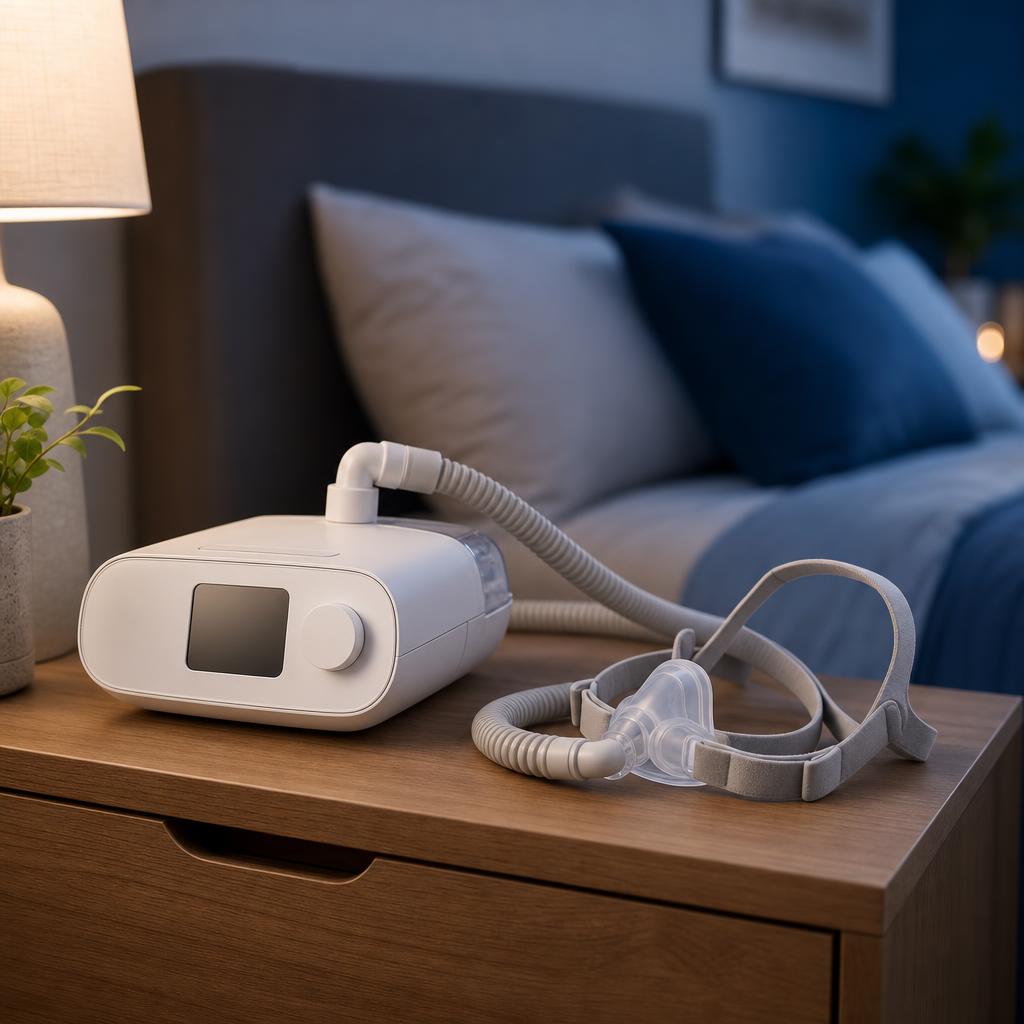
Obstructive sleep apnea (OSA) is one of the most common medical conditions we manage at Go Flight Medicine — and for years, it carried one of the most paperwork-heavy certification processes in aviation medicine. That changed on May 27, 2026, when the FAA retired its separate initial and recertification status summary forms and replaced them with a single, dramatically simpler document: the OSA Treated Status Report.
This article covers the history of the FAA's OSA policy, the key definitions every pilot should understand, how your Aviation Medical Examiner (AME) approaches sleep apnea at the exam, and what the initial and recertification Special Issuance (SI) requirements look like under the new guidance. For a deeper dive into the full OSA policy — screening, diagnosis, and every treatment pathway — see our complete guide: FAA Obstructive Sleep Apnea (OSA) Policy: The Complete Pilot's Guide.
A Brief History of the FAA's Sleep Apnea Policy
Sleep apnea has significant flight-safety implications. Untreated OSA causes fragmented, non-restorative sleep, which leads to excessive daytime sleepiness, impaired cognition and reaction time, and downstream cardiovascular disease. The National Transportation Safety Board has cited undiagnosed or untreated sleep apnea in multiple transportation accident investigations across aviation, rail, and highway modes.
In late 2013, the Federal Air Surgeon announced plans to require sleep apnea screening for all pilots with a body mass index (BMI) of 40 or greater — with the stated intent of lowering that threshold over time. The proposal generated substantial pushback from the pilot community and industry groups, who worried that BMI alone would trigger costly sleep studies for airmen with no symptoms at all.
The result, finalized in 2015, was a more balanced screening protocol that remains the foundation of today's policy: rather than automatic testing at a BMI cutoff, the AME performs an individualized risk assessment at every exam and triages the airman into one of six groups (more on that below). Critically, pilots identified as at-risk could continue flying while their evaluation was completed — no immediate grounding.
Since 2015, the FAA has progressively streamlined the documentation side. OSA became eligible for an AME Assisted Special Issuance (AASI), meaning most treated pilots renew through their AME rather than waiting on Oklahoma City. Standardized status summary worksheets — one for initial certification, a different one for recertification — replaced free-form physician letters. And in May 2026, those two worksheets were consolidated into the single OSA Treated Status Report we have today.
Definitions: The Terms That Matter
- Obstructive Sleep Apnea (OSA): Repeated collapse of the upper airway during sleep, causing pauses in breathing (apneas) or shallow breathing (hypopneas). It is the most common form of sleep-disordered breathing. Central and complex (mixed) sleep apnea are related conditions with different mechanisms — all are disqualifying until effectively treated.
- AHI (Apnea-Hypopnea Index): The average number of apnea and hypopnea events per hour of sleep, measured on a sleep study. Roughly: fewer than 5 is normal, 5–14.9 is mild, 15–29.9 is moderate, and 30 or more is severe. The FAA also looks at your residual AHI on treatment — the goal is 5 or less.
- Sleep study (polysomnography): The diagnostic test for OSA. Type I studies are attended, in-lab tests; Type II are comprehensive unattended home studies. Home sleep apnea tests (Type III/IV) are common in civilian medicine, but if you plan to use any treatment other than PAP, the FAA expects your diagnosis to rest on a Type I or II study.
- PAP (Positive Airway Pressure): The gold-standard treatment. Includes CPAP (continuous), AutoPAP (auto-titrating), and BiPAP (bi-level). Modern devices record nightly usage data — which is exactly what the FAA cares about.
- Oral appliance: A custom dental device that advances the lower jaw to keep the airway open. Acceptable to the FAA in appropriate cases, generally with follow-up testing to prove it works.
- Special Issuance (SI): A time-limited discretionary authorization under 14 CFR 67.401 for a condition that is otherwise disqualifying. OSA is managed under an AASI, which delegates renewal authority to your AME.
How Your AME Approaches OSA: The Six Groups
At every FAA medical exam, the AME is required to triage each applicant into one of six groups on the FAA OSA flow chart:
- Group 1 — Already on a Special Issuance for OSA. The AME follows the AASI, notes it in Block 60, and issues if you're otherwise qualified.
- Group 2 — Prior sleep assessment, no SI yet. If you're under treatment, the AME provides the AASI requirements and Specification Sheet A; the FAA will send a letter giving you 90 days to submit your documentation. You can still be issued at the exam.
- Group 3 — Not at risk. Documented in Block 60; certificate issued normally.
- Group 4 — At risk, but low risk. The AME discusses OSA risks, provides educational resources, and issues. No testing required.
- Group 5 — At high risk. The AME issues (if otherwise qualified) and provides Specification Sheet B — you'll have 90 days to obtain a sleep evaluation and submit results.
- Group 6 — Severe symptoms representing an immediate safety risk. The AME must defer. This is rare.
Two points deserve emphasis. First, risk assessment is clinical judgment informed by the American Academy of Sleep Medicine criteria — not a simple BMI cutoff. That said, the numbers are sobering: over 90% of individuals with a BMI of 40+ have OSA requiring treatment, while up to 30% of people with OSA have a BMI under 30. Anatomy (a recessed jaw, large tonsils or tongue), refractory hypertension, diabetes, and atrial fibrillation all raise suspicion regardless of weight. Second, in nearly every group, you keep flying while the process plays out. Fear of grounding should never keep a sleepy pilot from getting evaluated — untreated OSA is far more dangerous to your certificate (and your health) than the diagnosis.
The Old Process: Two Forms and a Stack of Paper
Until May 2026, treated pilots dealt with two different FAA worksheets — an initial status summary for the first Special Issuance, and a recertification status summary for annual renewals. On top of the form, pilots routinely had to submit:
- The most recent diagnostic sleep study (for initial certification);
- PAP compliance downloads demonstrating at least 75% nightly usage, a minimum of 6 hours per night, and a residual AHI of 5 or less — generally covering 30 days for initial certification and the full prior year for renewals;
- A compliance attestation form completed by the airman; and
- Supporting documentation from the treating physician.
It was manageable, but it meant gathering reports from multiple sources every single year — and gave the FAA and AMEs thousands of pages to review that rarely changed the outcome for well-treated pilots.
The New Process: One Form for Everyone
As of May 27, 2026, the FAA uses a single standardized document — the OSA Treated Status Report — for both initial certification and annual recertification of pilots whose OSA is treated with CPAP, AutoPAP, BiPAP, or an oral dental appliance.
How it works:
- You (the pilot) complete the top section of the form.
- Your treating sleep physician completes the bottom section.
- You bring the completed form to your FAA medical exam.
If every answer on the form falls in the "Yes" column, your AME can typically issue your medical certificate on the spot with a one-year time limitation. If any answer falls outside the acceptable criteria, the AME defers the application to the FAA for review.
The biggest win is what you no longer have to submit. When the form is all "Yes," sleep studies, compliance downloads, and stacks of supporting records generally stay in your file at home — your physician attests to compliance and treatment effectiveness on the form itself. Keep those records, though: the FAA can still request them, and your sleep physician needs your compliance data to complete their section honestly.
Initial Certification Requirements Under the New Guidance
If you're newly diagnosed with OSA (or a diagnosed pilot seeking your first medical certificate), the pathway now looks like this:
- Get effectively treated. For PAP therapy, that means consistent nightly use — the benchmarks remain at least 75% of nights, 6+ hours per night, and a residual AHI of 5 or less. For oral appliances, effectiveness generally must be confirmed with a follow-up Type I or II sleep study, depending on your baseline AHI.
- Establish care with a sleep medicine provider who can review your treatment data and complete the physician section of the OSA Treated Status Report.
- Complete the OSA Treated Status Report — your section and your physician's — and bring it to your FAA exam.
- Keep your source documents on hand: your most recent sleep study and compliance downloads, in case any form answer requires FAA review or the FAA requests them.
Pilots treated surgically (including hypoglossal nerve stimulation, i.e., Inspire therapy) follow separate requirements — typically documentation of treatment efficacy and a post-treatment sleep study demonstrating resolution. Talk to your AME before your exam if that's your situation.
Recertification (Annual Renewal) Requirements
Renewal under the OSA AASI is now the same drill: a freshly completed OSA Treated Status Report each year, presented to your AME at your exam. All-"Yes" answers mean your AME can renew your certificate with the standard one-year limitation — without the annual ritual of 12-month compliance report submissions. Ongoing follow-up with your sleep physician remains essential, both for your health and because their attestation is what powers the form.
What This Means for Go Flight Medicine Patients
We've updated the sleep apnea protocol checklist in our patient portal to reflect the new guidance — the old initial and recertification status summary links have been replaced with the single OSA Treated Status Report, and the supporting items now explain when sleep studies and compliance data actually need to leave your filing cabinet.
If your OSA is well treated, this change genuinely works in your favor: fewer documents to chase, faster review at your exam, and a clearer standard for what "good" looks like. If you're a pilot who has been avoiding a sleep evaluation out of fear for your medical certificate, let this be your nudge — the modern pathway is straightforward, and treated OSA pilots fly every day.
Questions about your specific situation? Contact Go Flight Medicine or schedule an appointment with one of our AMEs — we handle OSA Special Issuances routinely at every one of our clinics.
References
- FAA Guide for Aviation Medical Examiners — Obstructive Sleep Apnea Protocol (updated May 28, 2026)
- FAA OSA Treated Status Report (PDF)
- FAA OSA Reference Materials
- AME Assisted Special Issuance (AASI) for OSA (PDF)
- Wingman Med — Understanding the New OSA Treated Status Report
- Wingman Med — OSA Treatment for Pilots