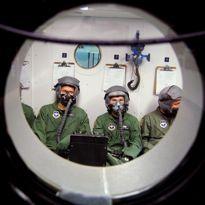

Aerospace and Operational Physiology (AOP) has the unique challenge of bridging physiologic sciences with the operational environment. Topics include fatigue, shiftwork analysis, cognitive workload, stress, man/machine design, thermal stressors, and mishap investigation.
HISTORY OF U.S. MILITARY AEROSPACE PHYSIOLOGY

Our roots trace back to Otto van Guerick (1602-1686), who invented the world's first air pump in 1650. In 1671, Robert Hooke invented the world's first altitude chamber.

During WWI, of the 100 aviators killed, 90 were caused by 'human error.' This led to the dawn of aerospace medicine and aviation physiology.


See also: Gas Laws | Hypoxia | Decompression Sickness
Need an FAA Medical Exam?