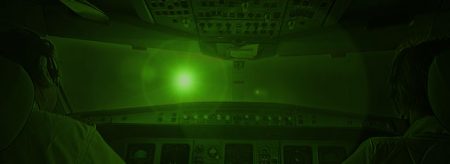

The crux of aerospace medicine is the identification of medical conditions that lead to sudden and unanticipated incapacitation of the flyer. One common source for potential in-flight incapacitation is acute ocular injury secondary to LASER exposure.
LASERS
L.A.S.E.R. stands for Light Amplification by Stimulated Emission of Radiation. Each LASER operates within its unique wavelength based on the optical spectrum.


PATHOPHYSIOLOGY
Lasers cause tissue injury through mechanical, thermal, or phototoxic mechanisms. The retina is most at risk due to its absorptive pigment epithelium.
INJURY INCIDENCE & POLICY

The FAA reported 5,352 exposures in 2015. The DoD has established a 24/7 Tri-Service Laser Hotline (1-800-473-3549).
Recommendations:
- Incidental, non-sustained laser pointer exposure poses no concern for long-term injury
- Rapid ocular assessment is required for any exposed aircrew member
- LASER eye protection (LEPs) should be used when exposure to powerful lasers is possible
- Return to flying duty without waiver is reasonable with no symptoms and benign evaluation
Need an FAA Medical Exam?