This article summarizes AMCD’s November 18, 2026 briefing and the FAA’s published update bulletin, disposition tables and supporting guidance. Some older FAA URLs still display earlier policies; use the current documents linked below. Your individual FAA authorization and applicable published FAA requirements govern your case.
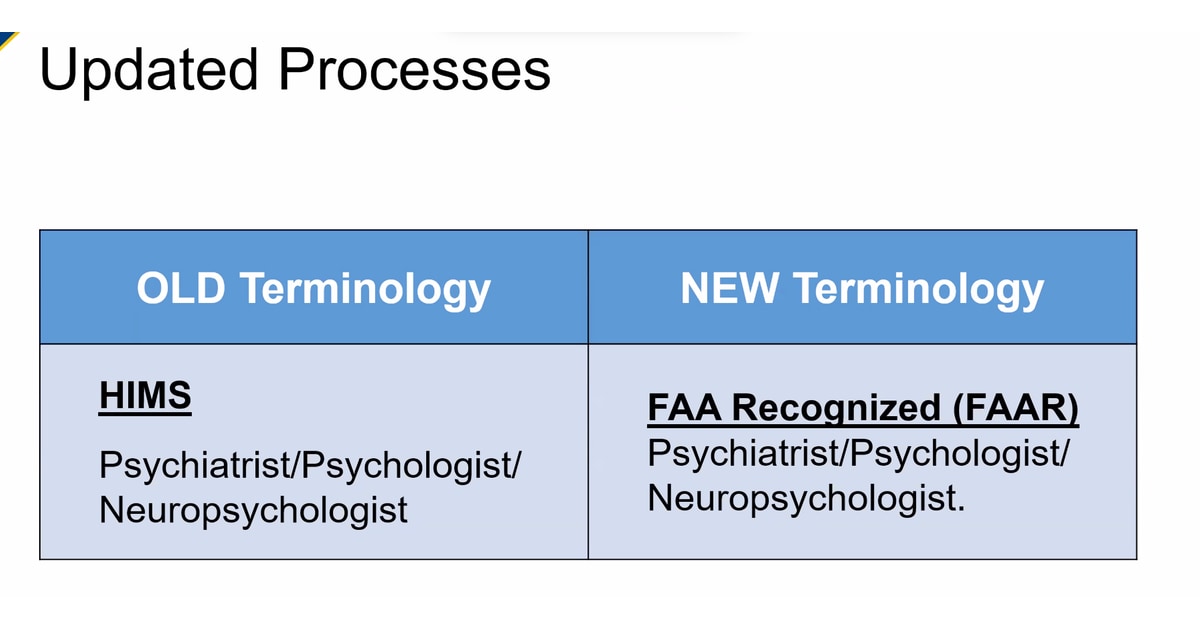
Summarized from AMCD’s briefing slides. The updated AME Guide and disposition tables are what officially count, so confirm details with your AME.
Do not stop or change medication without your treating clinician. Do not use this summary as clearance to fly or return to flying; confirm your eligibility and any medication-change requirements with your AME.
Big picture
- Simpler process: the confusing decision paths are gone, documentation is clearer, and most antidepressant cases now go through an AASI (AME Assisted Special Issuance).
- Fewer specialist visits. Special issuance (SI) cases are now processed at AMCD instead of FAS HQ, which should be faster.
- More of the decisions are now made by your AME, and you get more room to adjust doses without a long grounding.
New terminology
- “HIMS psychiatrist/psychologist/neuropsychologist” is now “FAA Recognized (FAAR)” psychiatrist/psychologist/neuropsychologist.
Antidepressants
- The new on-treatment and off-treatment disposition tables reorganize the process formerly described through the SSRI decision paths. The FAA had already expanded its antidepressant terminology beyond SSRIs in earlier updates; this is not the first expansion beyond SSRIs.
- Regular AMEs (not only HIMS AMEs) can now follow pilots on SI/AASI for antidepressant use.
- To qualify initially: an approved diagnosis (anxiety, depression or a related condition), plus 90 days of documented stability on the same dose of one FAA-approved antidepressant.
- What gets submitted: complete mental health records, a typed, signed and dated personal statement, a FAAR neuropsychologist evaluation with cognitive testing, and the required clinical evaluation and Mental Health History Checklist. If your prescriber is a board-certified psychiatrist, they supply the recent clinical progress note and signed checklist. Otherwise, submit your treating provider’s progress note plus a comprehensive assessment and signed checklist from an independent board-certified psychiatrist. Initial certification is deferred to the FAA; the AME does not issue the initial authorization in the office.
- Follow-up on an AASI: the November 18 FAA guidance requires all interim Detailed Clinical Progress Notes (DCPNs), including visits at least every six months. At least one of those visits and its progress note must be from an MD or DO; the other may be with a PA or NP. The most recent progress note must be no more than 90 days before the AME exam. The treating physician and AME also complete the Anxiety, Depression, and Related Conditions Status Summary–Recertification. Follow your individual authorization for any additional requirements.
- Old rule: psychiatrist, treating physician and HIMS AME visits, each twice a year.
- Follow-up on a full SI (less common, more complicated cases): an AMCD mental health reviewer sets it. It may include more frequent provider visits, a board-certified psychiatrist, or a counselor/therapist.
Changing meds while on SI/AASI
- The November 18 medication-change guidance applies to current FAA authorizations (AASI/SI/SC). The key distinction is what your individual authorization permits—not simply whether the letter says AASI or SI.
- Dose change of a previously approved medication: a minimum of 30 days of self-grounding and documented clinical stability. Return without prior FAA approval is allowed only if the authorization letter explicitly permits it. In that case, the treating provider documents stability and no clinical reports need to reach the FAA before return to flight duties.
- If your authorization does not permit return after a dose change: complete the minimum 30-day period and submit the treating provider’s DCPN to the AME or FAA for review. Do not treat 30 days alone as clearance to fly.
- Switching medications, including within the same class: a minimum of 90 days of self-grounding and clinical stability, followed by FAA review and approval before return to flight duties.
- Adding another medication: remain grounded; the AME must defer, and FAA review and approval are required.
- ATCS: all medication and dose changes must be cleared with the Regional Flight Surgeon’s office. Do not apply the pilot return-to-flight rules to air traffic control duties.
Stopping meds while on SI/AASI
- Decide together with your treating provider.
- Self-ground for 60 days to watch for symptoms coming back.
- Submit a DCPN documenting the decision and subsequent stability for FAA review and approval before returning to flight duties. Completing 60 days alone does not authorize a return.
History of anxiety/depression, now off treatment: new middle tier
- 5+ years off treatment and symptom-free: your AME can issue using the Fast Track Decision Tool. No treating-provider evaluation is needed; the AME fills out a Mental Health History Checklist.
- 2–5 years: your AME may issue if all Fast Track criteria are met. Required materials include a typed, signed and dated personal statement, complete mental health records, a comprehensive clinical psychiatric evaluation by an appropriate community clinician or FAAR psychiatrist, and the completed and signed Mental Health History Checklist.
- Previously, qualifying uncomplicated cases could be considered for AME issuance after two or more years off medication, subject to all screening and disposition criteria—not simply the passage of time.
- Under 2 years since the last treatment or symptoms: defer to the FAA. Required materials include a personal statement, complete mental health records, a comprehensive independent psychiatric evaluation by a FAAR psychiatrist, and the checklist completed and signed by that psychiatrist. A simple progress note is not a substitute for this evaluation.
- Automatically treated as the under-2-years case, regardless of time: recurrent major depression, repeated failed attempts to come off meds, ever taking two or more psych meds at once, dysthymia, or seasonal affective disorder.
- Measure the interval from the last treatment or last active symptoms, whichever is more recent. Every Fast Track screening answer must be “No”; missing required records, a positive checklist item, or an AME concern means deferral rather than automatic issuance.
Other changes
- Antidepressants for non-mental-health conditions have their own table. After at least four weeks on an acceptable medication with resolved symptoms and no side effects, submit the required progress note, Mental Health History Checklist and underlying-condition records. The table does not list routine neurocognitive testing, but the FAA may request additional evaluation. The medication requires a Special Issuance/Special Consideration, and the underlying condition must also satisfy its own FAA guidance.
- The Fast Track Decision Tool used to be only for already-deferred cases. It’s now the main path for the 2–5 and 5+ year groups. Situational depression gets its own separate fast-track tool.
- The PTSD table is gone. PTSD now falls under the anxiety/depression/related conditions table.
- New forms: a Mental Health History Checklist (11 yes/no questions your provider completes) and an Antidepressant Initial Document Checklist, which you use to check your packet is complete and don’t send to the FAA.
Little to no change
- Therapy alone still doesn’t have to be reported between exams (depending on diagnosis).
- The ADHD process is unchanged.
- You still need 90 days of stability on an approved antidepressant before applying for SI.
- Recurrent symptoms will usually still need treatment before you’re certified.
- Psychosis, bipolar or personality disorders, and suicide attempts have dedicated new disposition tables. These require individualized application of the FAA’s criteria; do not assume eligibility or exclusion from this short summary.
Official FAA references and verification notes
The linked FAA documents take precedence over a short briefing summary. Progress notes are required at least every six months under the AASI guidance; dose-change permissions depend on the individual authorization letter; initial certification on treatment requires FAA deferral and review. New FAAR terminology does not replace the separate HIMS AME designation. Pilot and ATCS requirements differ.
AME Guide and update bulletin
New disposition tables and pathways
- Anxiety, Depression, and Related Conditions — ON Treatment
- Anxiety, Depression, and Related Conditions — OFF Treatment
- OFF Treatment — Fast Track Pathway for the AME
- Antidepressant Medication for Non-Mental Health Conditions
- Suicide Attempt(s) — Disposition Table
- Bipolar, Psychosis or Personality Disorder(s) — Disposition Table
- Situational Depression — Disposition Table
Medication changes and ongoing certification
- Antidepressant Medication Changes With a Current FAA Authorization
- FAA-acceptable Antidepressant Medications
- AASI for Anxiety, Depression, and Related Conditions
- Anxiety, Depression, and Related Conditions — Status Summary, Recertification
Forms, checklists and certification instructions
- Mental Health History Checklist
- Antidepressant Initial Certification — Document Checklist
- FAA Certification Aid — Antidepressant Initial Certification
- Pilot Information — Certification Steps, ON Treatment
- AME Mental Health Quick Decision Guide
- Pilot Information — Detailed Clinical Progress Note
FAA Recognized evaluators
- Who Do I Need to See? Navigating FAA Mental Health Evaluators
- FAAR Neuropsychologist — Eligibility, Maintenance and Scope
- FAAR Psychologist — Eligibility, Maintenance and Scope
- FAAR Psychiatrist Directory
- FAA Psychologist and Neuropsychologist Directory — check provider type