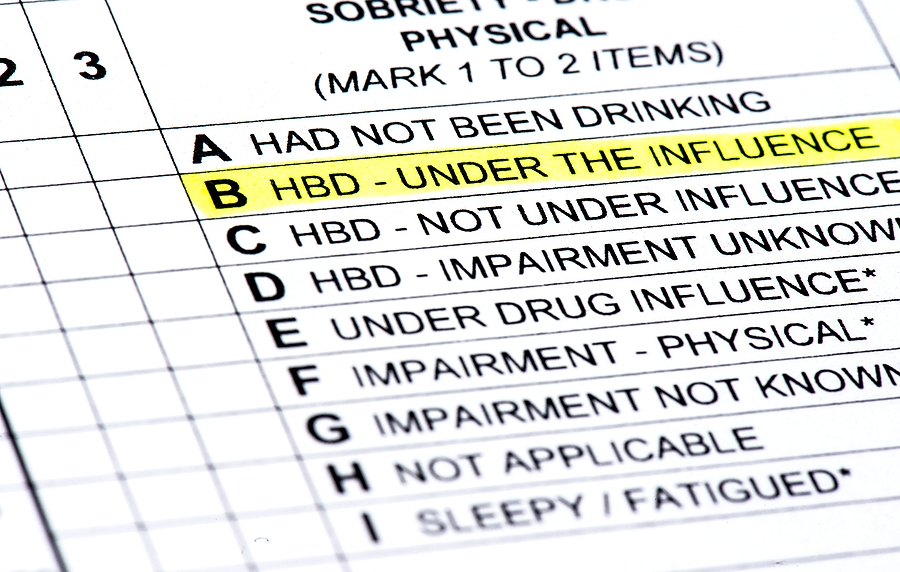
If you're a pilot facing a substance-related issue — whether it's a DUI, a failed drug or alcohol test, or a self-disclosure — you've probably come across the term "HIMS AME" and have a lot of questions. The HIMS program can feel overwhelming, but understanding how it works is the first step toward getting back in the cockpit. Below are the most frequently asked questions we receive about HIMS AMEs and the HIMS process.
What Is a HIMS AME?
A HIMS AME (Human Intervention Motivation Study Aviation Medical Examiner) is a specially trained FAA-designated physician who is authorized to evaluate and monitor pilots with substance use issues. Not all AMEs hold HIMS designation — in fact, only a small percentage of AMEs are HIMS-qualified. These physicians have completed additional FAA-approved training focused on substance use disorders, recovery monitoring, and the specific regulatory requirements for returning substance-involved pilots to flight status.
HIMS AMEs serve as the bridge between the pilot, the FAA, and the treatment/monitoring community. They are responsible for conducting initial evaluations, coordinating required testing and documentation, and ultimately recommending (or not recommending) a pilot for Special Issuance medical certification.
What Is the HIMS Program?
The HIMS program is the FAA's structured process for identifying, treating, and monitoring pilots who have substance use disorders or substance-related events. Originally developed in the 1970s through a collaboration between the Air Line Pilots Association (ALPA) and the FAA, it has since expanded to cover all certificate holders — not just airline pilots.
The program is built on the philosophy that substance use disorders are treatable conditions and that pilots who successfully complete treatment and demonstrate sustained recovery can safely return to flying. The HIMS program provides a framework for:
- Initial evaluation and diagnosis by qualified professionals
- Appropriate treatment (typically a 28-day inpatient program or equivalent)
- Ongoing monitoring including drug and alcohol testing
- Regular check-ins with a HIMS AME
- Peer support through AA/NA meetings or equivalent programs
- Gradual return to flying duties with continued oversight
What Is a HIMS Psychiatrist?
A HIMS psychiatrist is a psychiatrist who has successfully completed additional training in evaluating airmen for substance- or alcohol-related conditions or other conditions (such as the SSRI program). HIMS psychiatrists play a critical role in the evaluation and ongoing monitoring of pilots in the HIMS program.
Go Flight Medicine has developed a specialized HIMS Provider Search Tool for locating qualified HIMS psychiatrists, psychologists, and neuropsychologists experienced with FAA cases. This search tool is available exclusively through our proprietary patient portal for our HIMS patients, ensuring they have direct access to vetted providers who understand the specific documentation and evaluation requirements. If you are a Go Flight Medicine HIMS patient, log in to your portal to access this resource.
Is the HIMS Program the Same as a HIMS AME?
No. The HIMS program is an industry program — it is not the same thing as a HIMS AME. The airmen enrolled in this program are followed for FAA purposes by a HIMS AME, but the program itself is separate from the AME designation.
Not all commercial pilots use the HIMS Program — only airlines that have adopted it participate. The list of current carriers with a HIMS program can be found on the HIMS program website. For more information about the industry program, visit the HIMS program website.
When Do I Need a HIMS AME?
You will need a HIMS AME if any of the following apply to your situation:
- DUI/DWI: You have one or more alcohol or drug-related motor vehicle actions (arrests, convictions, or administrative actions)
- Failed DOT Drug or Alcohol Test: You tested positive on a DOT-mandated drug or alcohol screening
- Self-Disclosure: You voluntarily reported a substance use issue to the FAA
- Substance Use Diagnosis: You received a diagnosis of substance use disorder, substance abuse, or substance dependence from a healthcare provider
- Substance-Related Incident: Any event that brought your substance use to the FAA's attention
- Prior Denial or Revocation: Your medical certificate was denied or revoked due to substance-related concerns
- Mental Health Conditions: The FAA has expanded the role of HIMS AMEs to monitor and assist with certification for pilots who have a history of mental health conditions such as ADHD, depression, anxiety, PTSD, gender dysphoria, and other psychiatric conditions
- Antidepressant Use: Any pilot taking an antidepressant medication (such as SSRIs) is required to have a HIMS AME involved in monitoring their certification
If you're unsure whether your situation requires a HIMS AME, it's always best to consult with one before your next FAA medical exam. Going to a non-HIMS AME with a substance history can result in a deferral that significantly delays your certification.
How Do I Find a HIMS AME?
Finding a qualified HIMS AME is one of the most important steps in the process. You can search for HIMS AMEs through several resources:
- Go Flight Medicine's AME Search Tool: Our AME Search Tool allows you to filter specifically for HIMS-qualified AMEs by location, making it easy to find one near you
- FAA's AME Locator: The FAA maintains a directory of designated AMEs, though it can be difficult to filter for HIMS qualification specifically
- HIMS Academy: The organization that trains HIMS AMEs maintains a list of certified practitioners
- Pilot Unions: ALPA, SWAPA, and other unions often maintain referral lists
When choosing a HIMS AME, consider their experience level, location, availability, and willingness to guide you through the process. An experienced HIMS AME can make a significant difference in how smoothly your case progresses.
What Happens at My First HIMS AME Appointment?
Your initial HIMS AME evaluation is more comprehensive than a standard FAA medical exam. Here's what to expect:
- Detailed History Review: The AME will review your complete medical, psychiatric, and substance use history in detail. Be thorough and honest — omitting information will only create problems later.
- Physical Examination: A standard FAA medical examination will be performed.
- Documentation Review: The AME will review any treatment records, evaluations, court documents, or other relevant paperwork you bring.
- Discussion of the Process: The AME will explain the HIMS pathway specific to your case, including what evaluations, testing, and documentation the FAA will require.
- Action Plan: You'll leave with a clear understanding of next steps — which may include obtaining a substance abuse evaluation, neuropsychological testing, lab work, or other requirements.
Plan for this appointment to take longer than a typical flight physical. Bring all relevant documentation, including treatment records, court documents, prior FAA correspondence, and any evaluations you've already completed.
What Is a Substance Abuse Evaluation (SAE)?
A Substance Abuse Evaluation is a comprehensive clinical assessment performed by a qualified professional — typically a PhD-level psychologist or psychiatrist experienced with FAA cases. In some cases, the SAE can also be performed by an addictionologist with a degree in counseling or therapy. The SAE is one of the most critical documents in your HIMS file. It will include:
- A detailed psychosocial history
- Assessment of substance use patterns and severity
- Clinical diagnosis using DSM-5 criteria
- Treatment recommendations
- Prognosis for sustained recovery
It's important that your evaluator understands FAA requirements. A poorly written or incomplete SAE can delay your case by months. Your HIMS AME can usually recommend qualified evaluators in your area.
How Long Does the HIMS Process Take?
This is one of the most common questions we receive, and the honest answer is: it depends. The timeline varies significantly based on your specific circumstances:
- Single DUI with no diagnosis of dependence: Approximately 3–6 months from initial evaluation to Special Issuance, assuming all documentation is submitted promptly
- Substance dependence diagnosis requiring treatment: Typically 12–18 months or longer, including treatment time and the initial monitoring period before the FAA will consider certification
- Multiple events or complex history: Timelines can extend significantly depending on the specifics
The biggest factors affecting your timeline are:
- How quickly you gather and submit required documentation
- The complexity of your case
- FAA processing times (which can vary)
- Whether your initial submission is complete and accurate
Working with an experienced HIMS AME who knows exactly what the FAA wants — and submits a clean, complete package — can significantly reduce delays.
What Are the Phases of the HIMS Program?
Once you receive your Special Issuance medical certificate, ongoing monitoring is required. The HIMS program is divided into phases that gradually reduce the intensity of monitoring as you demonstrate sustained recovery:
For the full FAA HIMS Step-Down Plan diagram with detailed testing requirements, visit the FAA HIMS AME Step Down Plan (PDF).
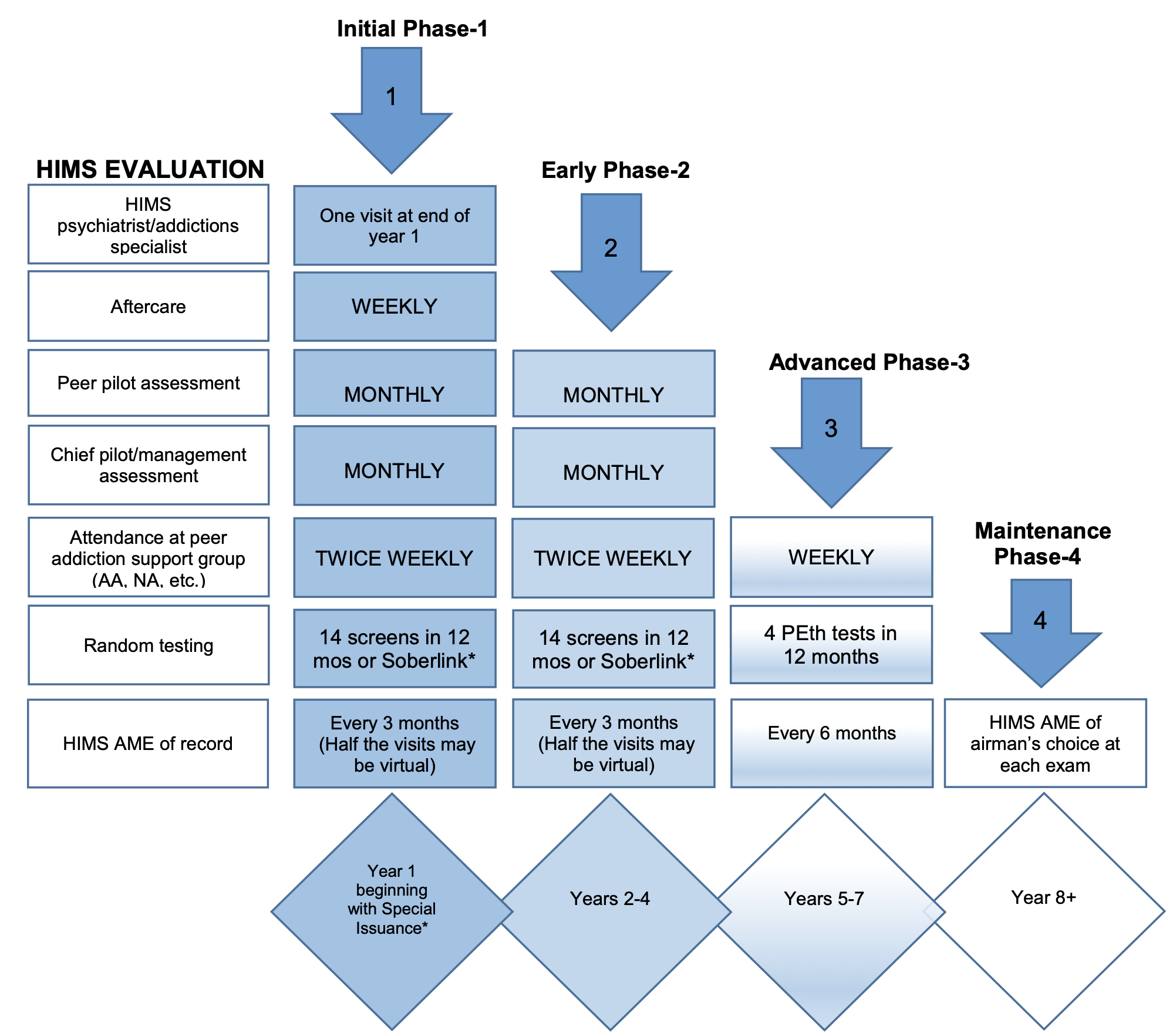
FAA HIMS AME Step Down Plan — Phase progression from Initial (Year 1) through Maintenance (Year 8+)
Phase 1 — Initial Certification (Year 1)
- Aftercare weekly for the first year
- HIMS psychiatrist/addictions specialist visit at end of year 1
- 14 random drug/alcohol screens in 12 months and/or mobile alcohol monitoring (e.g., Soberlink)
- Peer support group attendance (e.g., AA) twice weekly
- Chief pilot/management assessment monthly
- Peer pilot assessment monthly
- HIMS AME visits every 3 months (half may be virtual)
Phase 2 — Early Recovery (Years 2–4)
- 14 random drug/alcohol screens in 12 months and/or mobile alcohol monitoring (e.g., Soberlink)
- Peer support group attendance (e.g., AA) twice weekly
- Chief pilot/management assessment monthly
- Peer pilot assessment monthly
- HIMS AME visits every 3 months (half may be virtual)
Phase 3 — Advanced Recovery (Years 5–7)
- Random PEth testing (plus drug screens if indicated) 4 times in 12 months
- Peer support group attendance (e.g., AA) weekly
- HIMS AME visits every 6 months
Phase 4 — Maintenance (Year 7+)
- HIMS AME of the airman's choice at each FAA medical exam
- Minimal testing and oversight requirements
- Permanent abstinence from mind and mood altering substances remains required for the duration of the flying career
Note: The time course listed is nominal and indicates the usual, uncomplicated progression of recovery. Progression is NOT automatic or guaranteed. Pilots may be required to repeat a phase if recovery evidence is insufficient. Testing frequencies are minimums and may be increased at the discretion of the HIMS AME. The Authorization Letter — not the Step Down Plan — is the binding document for your Special Issuance.
The specific requirements for each phase can vary based on your diagnosis, treatment history, and the FAA's determination for your individual case.
Who Can Authorize Phase Transitions in the Step-Down Program?
Understanding who has the authority to approve phase transitions is one of the most important — and most commonly misunderstood — aspects of the HIMS monitoring program. The rules differ depending on which transition is being made:
- Phase 1 to Phase 2: ONLY the FAA Office of Aerospace Medicine can make this determination. The HIMS AME cannot authorize the transition from Phase 1 to Phase 2 on their own.
- Phase 2 to Phase 3, or Phase 3 to Phase 4: The HIMS AME can make this determination, unless the Authorization Letter explicitly advises that the HIMS AME cannot initiate the step down. Always review your Authorization Letter carefully to understand who holds this authority for your specific case.
How Does the HIMS AME Determine Readiness for a Phase Transition?
When the HIMS AME has the authority to approve a phase transition, they follow a thorough review process. The HIMS AME reviews all documentation and interviews the pilot to determine if the following criteria are met:
- The pilot has demonstrated complete compliance with all current monitoring requirements
- The interview unequivocally demonstrates the pilot is sober from all substances of concern
- The pilot is in good recovery
- The HIMS AME has no concerns about the pilot's continued sobriety or fitness for duty
What Is Time-in-Phase?
Time-in-Phase is the minimum amount of time required for each specific Phase in which the pilot has an uncomplicated progression of recovery. This is an important concept because it sets the baseline for how quickly a pilot can move through the monitoring program.
The start date for Time-in-Phase is calculated from the date the initial Special Issuance is authorized by the FAA — not the date of the evaluation, application, or treatment completion.
Critical: If the pilot relapses or there is a withdrawal of authorization at any time during the monitoring program, the Time-in-Phase start date is reset to the date any new Special Issuance authorization is granted. This means the pilot must restart the minimum time requirements for their current phase from the beginning.
How Much Does the HIMS Process Cost?
The HIMS process involves several costs that pilots should be prepared for:
- HIMS AME evaluations: $200–$1,000 per visit (varies by provider and complexity)
- Substance Abuse Evaluation: $1,500–$4,000
- Neuropsychological testing: $2,000–$5,000 (if required)
- Treatment programs: Varies widely — insurance may cover some costs
- Ongoing drug/alcohol testing: $50–$100 per test
- Peer support program costs: Generally minimal or free
While the costs can be significant, many pilots find that the investment is worthwhile to preserve their career. Some employers and unions offer assistance programs that can help offset costs.
Can I Still Fly During the HIMS Process?
Generally, no. In most cases, your medical certificate will be revoked or denied once a substance-related issue comes to the FAA's attention. You will not be able to exercise pilot privileges until you receive a Special Issuance medical certificate through the HIMS process.
There are limited exceptions — for example, if you had a single DUI many years ago and have maintained your medical certificate since, you may still hold a valid medical. However, if the FAA takes action on your certificate or you're due for a renewal, you'll need to go through the HIMS process before flying again.
What Happens If I Relapse?
Relapse is taken very seriously in the HIMS program. If you test positive on a random drug or alcohol test, or if a relapse event is reported:
- Your medical certificate will likely be immediately revoked
- You will need to undergo additional treatment
- The monitoring clock typically resets
- Re-certification is possible but will require a longer monitoring period
The HIMS program is designed with the understanding that relapse can occur, and there is a pathway back. However, it emphasizes the importance of honesty, accountability, and genuine engagement with recovery.
Do I Need a HIMS AME for a Single DUI?
This is a nuanced question. Under FAA regulations, even a single alcohol or drug-related motor vehicle action must be reported to the FAA within 60 days using the FAA's DUI/DWI/Drug & Alcohol Event Notification portal. Whether you need a full HIMS evaluation depends on several factors:
- First offense with no diagnosis: The FAA may require a substance abuse evaluation and limited monitoring but may not require the full HIMS program
- First offense with diagnosis: If the evaluation results in a substance use disorder diagnosis, the full HIMS program will likely be required
- Multiple offenses: Multiple DUIs almost always trigger the full HIMS program regardless of diagnosis
Regardless of the specifics, consulting with a HIMS AME after any DUI is strongly recommended. They can help you understand what the FAA will require and ensure you don't inadvertently complicate your case.
What if the Airman Flies Recreationally or for an Airline Without a HIMS Program?
Airmen who do not work for a carrier with a HIMS program can still be monitored by a HIMS-trained AME to fulfill the requirements of their medical certificate as outlined by the FAA. Whether you are a recreational pilot, a general aviation pilot, or fly for an airline that has not adopted the HIMS industry program, the FAA still requires the same monitoring and oversight for substance-related Special Issuances. A HIMS AME or Independent Medical Sponsor can serve as your medical sponsor and coordinate all required monitoring, testing, and reporting on your behalf.
Important: FAA Reporting Requirement
Under 14 CFR 61.15, pilots are required to report any DUI, DWI, or drug and alcohol-related motor vehicle action to the FAA within 60 days of the event. Failure to report can result in certificate suspension or revocation — even if the underlying event would not have affected your medical.
Opens the official FAA DUI/DWI/Drug & Alcohol Event Notification portal
What's the Difference Between a HIMS AME and a Regular AME?
While all HIMS AMEs are also regular AMEs, the reverse is not true. Key differences include:
- Training: HIMS AMEs complete specialized training through the HIMS Academy covering substance use disorders, addiction medicine, and FAA-specific protocols
- Authorization: Only HIMS AMEs can conduct the required evaluations and monitoring for substance-related Special Issuances
- Experience: HIMS AMEs typically have extensive experience navigating FAA bureaucracy for complex cases
- Ongoing Education: HIMS AMEs must maintain their qualification through continuing education
Going to a non-HIMS AME for a substance-related issue is one of the most common — and costly — mistakes pilots make. A non-HIMS AME will be required to defer your application, adding months to your timeline.
What's the Difference Between a HIMS AME, an Independent Medical Sponsor, and an International/Military Sponsor?
The FAA maintains separate categories of HIMS-trained providers, and understanding the differences is important when building your monitoring team.
HIMS AME (Aviation Medical Examiner)
A HIMS AME is a fully designated Aviation Medical Examiner who has completed specialized HIMS training. They can do everything a regular AME does — including conducting FAA medical exams and issuing medical certificates — plus they are authorized to serve as your medical sponsor for substance-related monitoring. Think of the HIMS AME as the "quarterback" of your recovery team. They:
- Conduct your FAA medical examination and issue your certificate
- Coordinate with your peer sponsor, company sponsor, addiction counselor, and aftercare providers
- Review all monthly reports, drug/alcohol test results, and psychiatric evaluations
- Compile and submit your complete package to the FAA
- Make the determination (with FAA authorization) to move you through HIMS phases
- Can recommend revocation of your medical certificate if concerns arise
Many HIMS AMEs serve both roles — examiner and medical sponsor — making them a one-stop solution for pilots in the HIMS program.
Independent Medical Sponsor (IMS)
An Independent Medical Sponsor is a physician who has completed HIMS training but does not perform routine FAA medical examinations and cannot issue medical certificates. They serve exclusively in the medical sponsor/coordinator role and must work in conjunction with a separate AME who handles the actual certificate issuance.
An IMS performs the same monitoring and oversight functions as a HIMS AME acting as sponsor:
- Receives and reviews all monitoring inputs — peer sponsor reports, company sponsor reports, drug/alcohol test results, aftercare summaries, and psychiatric evaluations
- Orders random urine and blood testing as needed
- Coordinates the FAA re-certification process
- Serves as the FAA's "eyes on the target" for ongoing recovery assessment
- Has authority to delay certification or recommend revocation at any time
IMS providers are commonly used by pilots at airlines without formal HIMS programs, general aviation pilots, or situations where the pilot's geographic location makes it impractical to see a full HIMS AME for regular monitoring visits. Many IMS providers are former AMEs or airline medical directors who bring extensive experience to the role.
International and Military Sponsors
The FAA maintains a separate listing for HIMS-trained providers who operate in international or military contexts. These sponsors serve pilots who hold FAA certificates but are based overseas or serve in military aviation. Key points:
- International sponsors support FAA certificate holders living or working abroad who need HIMS monitoring — coordinating across time zones and potentially different healthcare systems while ensuring FAA compliance
- Military sponsors work within military medical systems while coordinating with FAA requirements for military pilots who also hold (or seek) FAA certificates
- Both categories are HIMS-trained and fulfill the same core monitoring functions, but operate under the unique constraints of their respective environments
Quick Comparison
| Feature | HIMS AME | Independent Medical Sponsor | Int'l / Military Sponsor |
|---|---|---|---|
| Can issue medical certificates | Yes | No — partners with an AME | Varies |
| Monitors recovery | Yes | Yes | Yes |
| Submits to FAA | Yes | Yes | Yes |
| HIMS trained | Yes | Yes | Yes |
| Typical context | All pilots (airline & GA) | GA pilots, non-HIMS airlines | Overseas & military pilots |
Bottom line: Most pilots in the HIMS program will work with a HIMS AME who handles both the medical examination and sponsorship roles. If a full HIMS AME isn't available in your area — or your situation calls for it — an Independent Medical Sponsor can fill the monitoring role while a separate AME handles your certificate. International and military sponsors serve the same essential function but are equipped to navigate the additional complexities of overseas or military service.
Can a HIMS AME Help with Issues Beyond Substance Use?
While the HIMS designation specifically relates to substance use cases, many HIMS AMEs have broad experience with complex FAA medical certification issues including:
- Mental health conditions (anxiety, depression, PTSD, ADHD)
- Cardiovascular conditions requiring Special Issuance
- Neurological conditions
- Complex medication situations
- Prior denials or revocations for any reason
The skills that make someone a good HIMS AME — attention to detail, knowledge of FAA processes, experience with Special Issuances — translate well to other complex certification cases.
Tips for Success in the HIMS Program
Based on years of experience working with pilots in the HIMS program, here are our top recommendations:
- Be completely honest. The FAA has access to more information than you might think. Omitting or minimizing information will backfire.
- Stay organized. Keep copies of every document, every test result, and every piece of correspondence. A well-organized file makes everything easier.
- Be proactive with documentation. Don't wait for the FAA to ask for something. Anticipate what they'll need and have it ready.
- Choose your team wisely. Your HIMS AME, evaluator, and treatment providers should all have experience with FAA cases.
- Comply fully with monitoring requirements. Missing a test or a meeting can set you back significantly.
- Be patient. The process takes time. Frustration is normal, but staying the course is essential.
- Engage genuinely with recovery. The pilots who do best in the HIMS program are those who embrace recovery rather than viewing it as a bureaucratic hurdle.
Have More Questions About the HIMS Process?
Every pilot's situation is unique, and the HIMS process can be complex. Whether you're just starting out or in the middle of the process, our team at Go Flight Medicine is here to help guide you through every step.
Learn About Our HIMS AME ServicesFree initial case review — we'll help you understand your options and next steps.