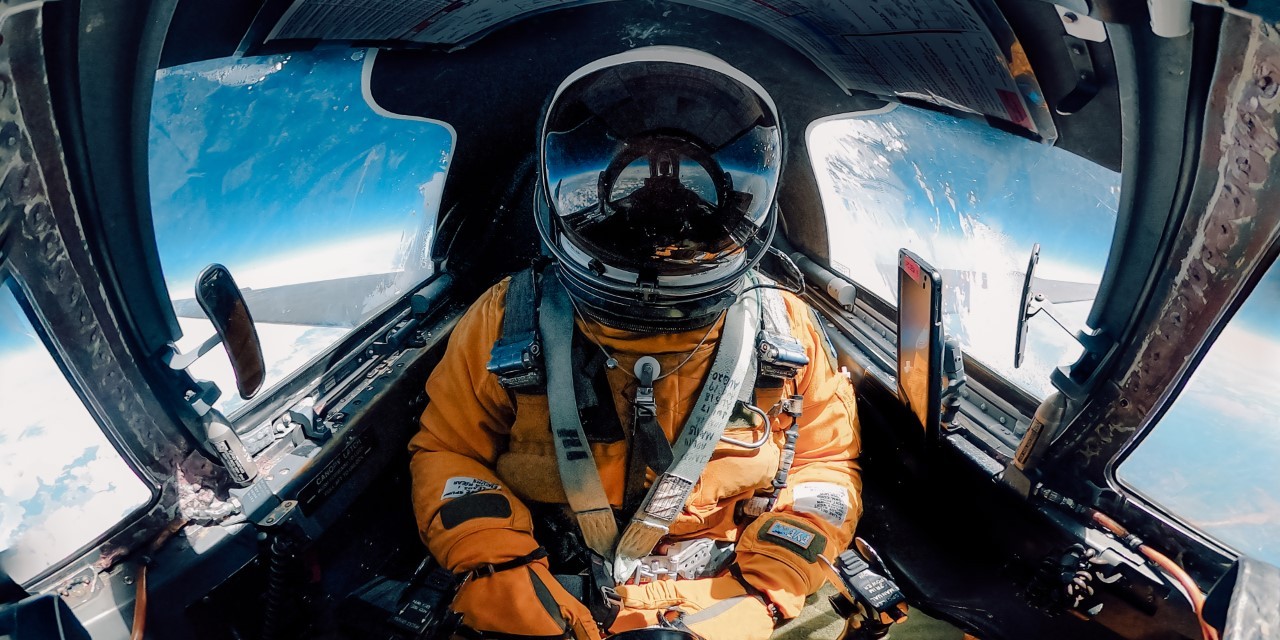

It is an exceedingly rare privilege for anyone aside from highly trained military pilots to don the yellow pressure suit and fly along the very edge of outer space in the infamous U-2 spy plane. But I was one of those lucky few...but first a story that may have led to this envious opportunity.
IN-FLIGHT EMERGENCY AT 70,000 FEET
So there I was...a typical day in the clinic when suddenly, all of my companion phones and radios began to ring in chorus. I was the flight surgeon on call at Beale Air Force Base north of Sacramento. It was an in-flight emergency (IFE). There had been an incident in the skies over Northern California involving one of my guys.

Usually when we get a call for an in-flight emergency (IFE), the call terminates as a false alarm before we even cover the 5 mile distance to the flight-line by ambulance. However, this IFE felt different from the start. Multiple calls all simultaneously? That's unique. I stared down at the screen on the call phone, unsure of what fate lied on the other side.
I cautiously swiped the green slider and was greeted by an anxious voice on the other end. "Is this the flight doc on call? We have a problem. One of the U2 pilots is having joint pain in the jet."
"I'll be right over." I said. My suspicions were correct. This was an unusual IFE call. However, this was a call I had been preparing for years.
U2 pilots are esteemed as the most talented and revered pilots in the skies - sometimes to demigod status in the aviation world. They fly into the stratosphere up to 70,000 feet above the earth's surface in a full pressure suit - alone, unarmed and unafraid. But this activity carries undeniable physiological risks.

Nitrogen gas, which is normally dissolved in your blood at ambient atmospheric pressure, can easily transition to gaseous phase with reductions in air pressure. These nitrogen bubbles, often termed the "bends" in scuba divers, can then lodge anywhere in your body causing major problems. The spectrum of this disease is known as Decompression Sickness (DCS). These small nitrogen air embolisms can lead to a variety of symptoms including rash, joint pains, loss of sensation, CNS symptoms, or even death.

On this particular day, the diagnosis was evident. Judging by the symptoms and ascent to high-altitude, the most worrisome cause of this pilot's joint pains was decompression sickness, a potentially disastrous malady for any aviator.
Fortunately in this case, the pilot was able to safely land the aircraft. The Dragon Lady pulled into her parking spot on the taxiway. I eagerly awaited next to the jet to greet the pilot after engine shutdown. Still in a cumbersome full pressure suit, the pilot gingerly stepped down the howdah and onto the hot tarmac.

At the hyperbaric chamber, we set him up for a 'dive' to 2.8 atm. My pilot's symptoms soon resolved and never resurfaced. I was so grateful. This case was one of the most fulfilling days of my career as a USAF Flight Surgeon.
AND THE DOCTOR TAKES FLIGHT
It wasn't long after I treated this DCS case that I got the opportunity that very few USAF flight surgeons will ever experience. One of the most memorable experiences in my life - my flight in the back of the Dragon Lady - a privilege only ~1350 souls have ever realized.

Soaring over 13 miles above the ground, relishing in the absolute bliss of seeing our expansive planet (and its curvature) below me, I couldn't help but feel sentimental. For over three years, I've been watching my pilots disappear into the stratosphere, in absolute awe of what they're able to do. After riding in the Dragon Lady myself, my respect for these aviators has only grown.
"Now I understand."
Needless to say, it is an experience I will cherish forever. Hail Dragons!